Voice AI Agents Are Replacing Contact Centers by 2026: What CX Leaders Must Know Now
AI Call Center Solutions in CX: Key Findings
- $47.5B market projection by 2034, signaling rapid enterprise adoption as voice AI becomes foundational to contact center strategies.
- 76.4% prefer integrated platforms, showing a shift toward full-stack solutions that simplify deployment and ensure regulatory compliance.
- 35% faster call handling, demonstrating how human-like AI agents are improving service quality while reducing queues and wait times.
It starts with the familiar: a phone rings. A customer exhales before answering, bracing for the usual loop of automated greetings, hold music, and transfers.
But this time, the voice on the other end doesn’t ask them to “press one for support.”
It listens. It responds. It even laughs at the right time.
The caller relaxes. The conversation flows. And only later do they realize: That wasn’t a person at all.
Luba Rein, Co-Founder, Chief Growth and People at Newo.ai, a platform that builds AI receptionists to replace traditional call centers, describes this as the future standard of customer service:
“No blinking lights. No grand announcement. It’s a case of AI agents stepping into the most human communication channel we have; our voice.”
And here’s what makes these AI agents remarkable:
- Calls that feel personal, even when they’re automated
- Conversations that start instantly, without queues
- Systems that sound natural enough to build trust
Editor's Note: This is a sponsored article created in partnership with Newo.ai.
The age of robotic customer support voices is ending not with a bang, but with believability.
What Call Centers Still Get Wrong
Even with full staffing, most inbound support teams miss more calls than leaders realize.
“They think coverage equals conversion, but calls still fall through the cracks,” Rein says. “The real losses happen in the gaps between systems, teams, and time zones.”
Some of it happens during peak hours. And some of it comes down to complex issues.
Things like figuring out which location serves a ZIP code, what services are offered where, and how to route overflow traffic in real time all contribute to the problem.
These blockers are a problem, as support teams lose between 9% and 30% of inbound calls during high-volume periods, according to Newo.ai.
And in multi-location setups, where IVRs often fail to route based on ZIP or service logic, that number only goes up.
Another Newo.ai report shows that even with two gatekeepers on duty, one client missed nearly 20% of calls before switching to AI.
With the right system in place, these kinds of slip-ups are preventable.
“Our AI receptionist acts as a full-service front desk that works across every location, every hour, every day,” Rein explains. “It listens like a person, books appointments on the spot, and knows which location can help, right down to the ZIP code.”
These AI call centers work with the tools teams already rely on, which means they can start making an impact straightaway.
To many call centers, this may sound too good to be true. But that’s what makes systems like Newo.ai so smart.
In one case with Image Orthodontics, internal reporting from Newo.ai showed the practice was missing 19.2% of inbound calls despite having a call center backup.
After deploying Newo.ai’s system, those missed opportunities translated into more than $401,000 in paid services recovered in a single quarter.
The Shift from Novelty to Necessity
The evolution from simple scripted bots to fully conversational voice AI agents has accelerated rapidly.
“Today, companies are not just experimenting but actively staffing these agents to scale without the constraints of traditional human teams,” Rein says.
They need systems that can handle growing call volumes without corresponding increases in headcount, respond instantly to every inbound opportunity, and maintain a human-like engagement that builds trust and satisfaction.
The Market Is Speaking, Literally
The momentum behind AI call center software is quantifiable and accelerating.
Double-digit compound annual growth rates point to enterprise adoption that is actively reshaping contact center strategies worldwide.
Increasingly, organizations are showing a preference for a full-platform AI answering service over standalone tools.
Specifically, industries with strict regulatory requirements tend to lean strongly toward secure, on-premises solutions.
“These trends indicate that voice AI technology is evolving from a novelty to a foundational component of customer service infrastructure,” says Rein.
Numbers That Explain the Shift
Now, the data confirms it: voice AI is fueling a fundamental transformation in customer service.
Key statistics from Market.us highlight this growth and its real-world impact:
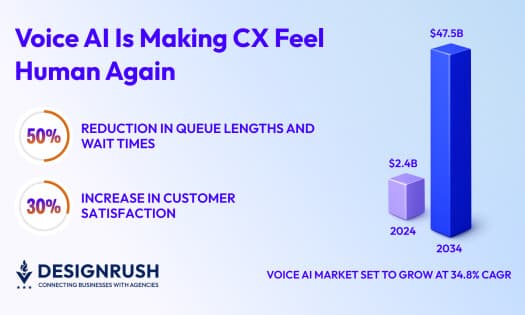
- The global market is projected to grow from $2.4 billion in 2024 to $47.5 billion by 2034, representing a robust 34.8% CAGR.
- North America holds more than 40% of the market share, reflecting early and strong adoption in key industries like finance, healthcare, and retail.
- 76.4% of the market demand is for fully integrated voice AI platforms, showing a preference for comprehensive solutions over point products.
- 62.6% of voice AI deployments are on-premises due to regulatory and security concerns, particularly in compliance-heavy sectors.
On the customer experience side, companies have reported:
- 35% faster call handling times
- 30% higher customer satisfaction scores
- Up to 50% reduction in queue lengths and wait times
These figures demonstrate that voice AI is scaling conversations and improving quality while driving business outcomes.
The Secret Weapon Is Speed
Early adopters are gaining a competitive advantage by deploying AI agents quickly and efficiently.
Instead of lengthy pilots that drag on for months, successful companies launch these agents in a matter of minutes.
The best part is that they seamlessly integrate voice AI with existing CRMs, calendars, and telephony systems.
This 24/7 availability allows businesses to capture every lead and service every caller, even outside traditional business hours.
“Platforms like Newo.ai exemplify this approach. By prioritizing rapid, realistic deployment, Newo.ai enables businesses to launch human-like AI agents in minutes that handle calls, chats, bookings, and support across channels with minimal coding or infrastructure changes,” Rein says.
What’s Next: Intelligence With Continuity
The next generation of voice AI will go beyond merely sounding human.
Future systems will maintain context across extended conversations, seamlessly linking insights from voice interactions with chat, email, and other channels.
Moreover, these AI agents will proactively engage customers based on predictive insights, enabling brands to anticipate needs before the customer even reaches out.
“And soon, the best voice AI won’t just answer calls,” Rein says. “It will understand the caller’s world.”
The Bigger Shift No One Talks About
The real transformation isn’t technological. It’s cultural.
A new balance is emerging in customer service, where:
- AI handles volume, humans handle complexity
- Automation eliminates repetition, not empathy
- Service teams escalate instead of regurgitating
“This shift protects human attention by removing the noise around it,” Rein says.
The Sound of the Future Isn’t Synthetic, It’s Responsive
The brands that will lead customer experience next won’t be the ones with the largest teams, the flashiest campaigns, or the boldest AI announcements.
They’ll be the ones who ensure no customer ever feels like they’re talking into silence.
Because the real competitive risk in 2026 isn’t bad automation. It’s no conversation at all.
If your brand doesn’t yet have a voice in the AI agent race, you’re not losing on capability, but losing on responsiveness, opportunity, and relevance.
The future of customer service is being shaped right now by the systems that answer first, adapt fastest, and make every caller feel heard.
“And maybe that’s the real disruption. The world won’t remember the brands that automated, it will remember the ones that finally stopped making customers wait for someone to respond,” Rein says. “Because the next great customer experience won’t be defined by humans or machines, but by who showed up when it mattered most.”
- #voiceai
- #customer-service
- #ai-agents
- #contact-center
- #cx-trends
Comments · 0