From Headset to Hard Hat: How a Customer Service Rep Became a Pipeline Welding Leader
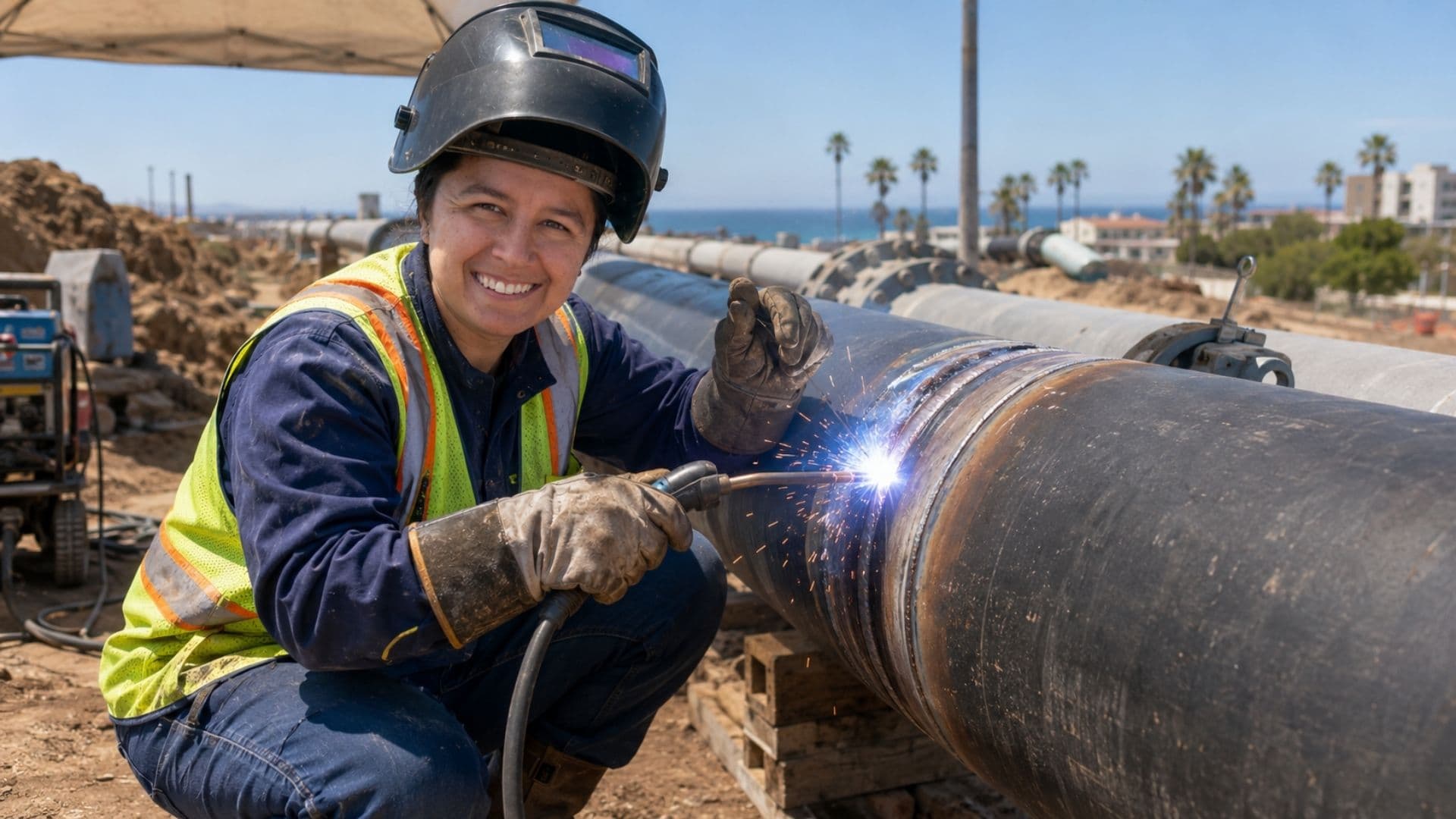
Swapping a call center headset for a welding mask is not a common change, but it was exactly the path taken by Kyla Hagge. After years in customer service and administrative roles, she transitioned to pipeline operations at SDG&E, San Diego Gas & Electric, a utility company in Southern California, USA. Her journey was featured by SDG&E Today, the company's own news channel.
From Customer Service to Pipeline Welding
Kyla's entry into the technical world was not by chance, but through a program. According to SDG&E, she joined the company through the “Intro to Construction Career” training initiative, created in partnership with the San Diego Workforce Partnership to bring people from outside the sector into construction and operations careers. It was the bridge that connected customer service to the construction site.
Once inside, she focused on the gas department. Instead of seeking an administrative role similar to the one she already had, Kyla chose to stay in the operational area and wait for the chance to become a welder, even knowing it was a difficult path. “I am very happy to have stayed in the gas department and pursued the opportunity to become a welder when my turn came,” she told SDG&E.
This decision required courage to start almost from scratch. Leaving an office routine to learn a manual and technical trade means facing a steep learning curve, with no guarantee of success. But it was precisely this willingness to reinvent herself that transformed a customer service employee into a qualified pipeline welder.
Her case fits into a growing movement. More and more people are leaving office and customer service jobs for technical careers, attracted by better salaries, stability, and the satisfaction of concrete work done with their own hands.
The 2nd Female Welder in SDG&E’s History
The achievement is significant because it is rare. SDG&E has over 140 years of history, and Kyla is only the second woman to become a welder at the company, following Noelya Collon, who paved the way as the first. In over a century of operation, very few women have held this position.
American market surveys indicate that about 5% of welders in the United States are women, a small number that highlights the size of the cultural and professional barrier. Each new female welder helps push the average up.
There is also a practical side. In an energy utility company, the position of welder usually comes with a robust salary, career plan, and stability. For Kyla, the risky bet of starting over was not only a personal achievement but also a leap in quality of life and income.
Who was the first: the path opened by Noelya Collon
Noelya Collon joined SDG&E as a gas construction assistant and, realizing that no woman had completed the welding school at the company, decided to be the first to try. Her determination led her from assistant to pioneering welder, opening the door that Kyla would later cross.
The pioneering spirit also became a team effort. Noelya joined the first all-female gas team at SDG&E, which went on to compete in the utility company’s traditional skills rodeo. It was the first time in over 140 years that an all-women team entered the competition.
What is welding a gas pipeline and why is it so difficult
Welding a gas pipeline is not the same as welding any metal piece. The job requires joining pipes that will transport gas under pressure, making each weld bead a matter of safety. A tiny flaw can become a leak, so the level of precision required is extremely high.
That’s why the training is tough and selective. The welding school combines physical effort, technical reading, and hours of practice until the hand gains steadiness. “Welding school was difficult, mentally and physically, but it was an extremely rewarding experience,” Kyla said.
In daily life, the craft mixes strength and delicacy. Gas teams cut pipes, fit polyethylene pipes into metal pipes, and connect everything to the main distribution lines, always following strict quality standards.
Why welding is critical for gas safety
Kyla’s role is at the heart of energy infrastructure. Pipelines are the arteries that carry natural gas from the main networks to homes, businesses, and industries. Each welded joint must withstand pressure, temperature variations, and decades of use. Without quality welding, there is no safe gas distribution.
Companies like SDG&E maintain strict pipeline integrity programs, with constant inspection, testing, and maintenance, and welders are a central piece in this system.
A well-paid craft in demand worldwide
Welding is one of those professions that debunks the idea that only a university degree guarantees a future. Well-paid and almost always in demand, it requires intense technical training, but not a four-year course. In many places, a qualified welder earns more than professionals with higher education.
In the energy sector, demand is still greater than supply. A large part of the technical workforce is aging and retiring, while few young people are entering to replace it. There is a lack of qualified hands to build and maintain pipelines, electrical networks, and other structures.
By bringing women and people from other areas into welding, the sector practically doubles the size of the available team and addresses the labor shortage.
From Welder to Team Leader
Kyla’s journey did not stop at the welding bench. Today, she works as a team leader, responsible for coordinating work on large-scale projects. In just a few years, she went from learning the trade to guiding her colleagues in the field.
Leading a gas crew is a new layer of responsibility. Besides welding, she needs to plan, distribute tasks, manage deadlines, and ensure the safety of all team members.
Kyla also uses her position to open doors for others. She participates in diversity and inclusion initiatives at the company and sees her own opportunities as a way to inspire those who come after.
Breaking the Stereotype in the Energy Sector
Kyla’s case is part of a larger movement. The energy sector has always been a male-dominated environment, especially in field roles. Seeing women taking on welding and team leadership is a recent and still timid, but concrete change.
Training programs have been the key to this turnaround. Initiatives like “Intro to Construction Career” show that the barrier is often in access, not capability.
What Brazil has to do with it: women in energy and gas
The discussion arrives in Brazil in full force. The country has a robust oil and gas industry, with pipelines, distributors, and an industrial park that depend on qualified welders and technicians. The female presence in these field positions is still small, but it grows year by year.
Brazilian energy companies are already pursuing this change. Petrobras, gas distributors, and companies in the electric sector have been creating programs to attract and train women in technical areas.
There is also a clear economic opportunity. Brazil faces a shortage of specialized technical labor, and truly opening welding and pipeline maintenance professions to women expands the available workforce.
And you, did you know a story like this?
Kyla Hagge’s journey proves that no stereotype is definitive: she switched from customer service to pipeline welding, became the second female welder in the history of San Diego’s energy utility, and today leads an entire team in one of the most technical and male-dominated trades in the sector.
- #pipelinewelding
- #careerchange
- #womenintrades
- #energysector
- #sdg&e
Comments · 0