AI Agents in Customer Service: How Enterprises Are Slashing Support Costs by 40% in 2026
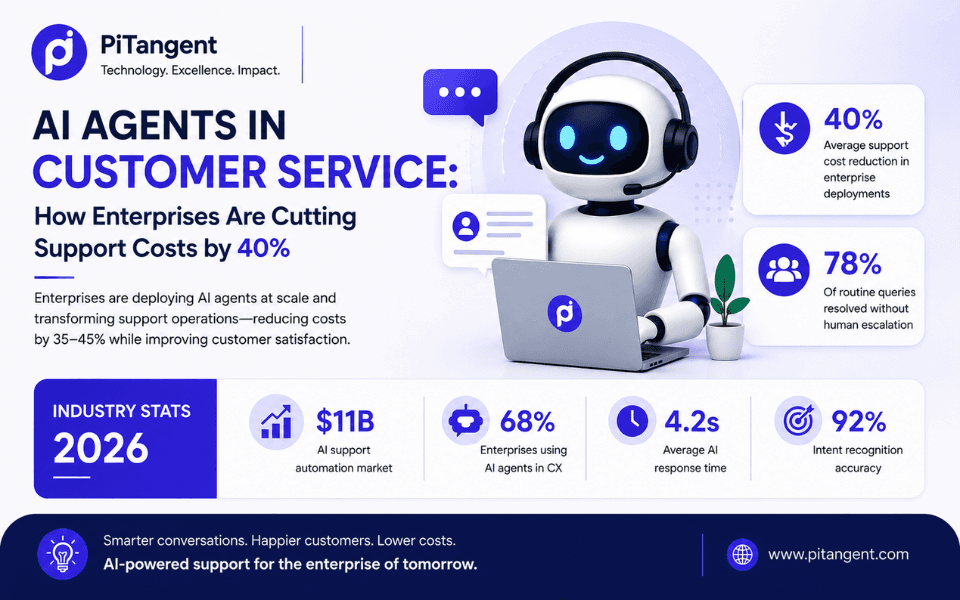
The customer service landscape has crossed a threshold. Enterprises that build AI agents for business are deploying them at scale and watching their support operations transform in real time in 2026. The most striking headline: companies are consistently slashing customer support costs by 35–45% and often improving customer satisfaction scores.
Why Conversational AI Has Finally Matured
Chatbots in enterprise support were a punchline—rigid decision trees dressed up in friendly UI. Customers hated them, and agents inherited the mess. The pivot to genuine conversational AI in 2026 is different for one fundamental reason: modern AI agents reason and route tickets. Today's AI customer service agent can parse ambiguous natural language and compose contextually accurate responses. Platforms built on large language models can handle nuanced billing disputes that would have required a Level 2 support specialist as recently as 2023.
Where the 40% Cost Reduction Comes From
The savings surface across several interconnected levers when enterprises build AI agents:
- Volume deflection at tier-1: AI agents autonomously resolve password resets and appointment scheduling, handling 60–80% of total ticket volume at most enterprises.
- 24/7 availability without overtime: Conversational AI support eliminates the cost premium of after-hours staffing and holiday coverage that compound quickly at scale.
- Faster handle times on hybrid queries: When agents do escalate to humans, AI passes a structured summary, so agents spend less time reading back through a conversation and more time resolving the issue.
- Centralized knowledge updates: AI agents update their knowledge bases centrally—no onboarding ramp, no retraining cost when policies change.
- Near-zero marginal cost: The cost of handling an additional query drops near zero once the infrastructure is deployed.
The AI Customer Service Practice in 2026
The architecture behind a modern AI customer service in 2026 looks markedly different from first-generation chatbot deployments. These systems integrate directly with CRM platforms and internal knowledge bases via APIs. They operate with defined guardrails, escalating gracefully to human agents when confidence is low or when a query falls outside their trained scope.
One telecommunications enterprise reported that after deploying a conversational AI platform across its support channels, CSAT scores for AI-handled interactions exceeded those of human-handled tier-1 interactions by 8 percentage points—because customers value speed and consistency above all else in routine transactions.
Key Considerations for Enterprise Deployment
The highest-ROI entry points for AI support automation are access management queries and first-line technical troubleshooting. These categories share common traits: high volume and clear resolution paths, making them ideal candidates for initial deployment before expanding scope.
The enterprises seeing the sharpest cost reductions are those treating the AI agent as a core layer in a broader service architecture that feeds data back into product teams and improves through feedback loops between AI performance and human review. The enterprises that sustain it past the first year are the ones that operationalize their AI agents as living systems.
Industry Stats 2026
- $11B AI support automation market
- 68% Enterprises using AI agents in CX
- 4.2s Average AI response time
- 92% Intent recognition accuracy
- #aiagents
- #customerservice
- #costreduction
- #conversationalai
- #enterprisesupport
Comments · 0